Big Small Malaysia – Tai-Sai Simple Dice Betting Guide
Big or Small is the entire decision at this table, one near coin flip repeated every round, and its exact cost is arithmetic anyone can check with three dice. This page shows how to state the house edge from first principles, price an evening in Ringgit, explain why the streak board on the table predicts nothing at all, and decide whether the fuller Sic Bo grid is worth graduating to.
The combination counts, probabilities and payouts below are the studio's published figures from the table rules and in-game info panel, and they are arithmetic you can check yourself with three dice. We hold them up against the live lobby the way our review methodology requires, and where a rule varies between tables, such as the triple bet menu, we say so instead of describing one table as the standard.
Big Small (Tai-Sai) is about the most beginner-friendly live dice game you will find at most Malaysian live casinos. The entire game boils down to a single call: will the combined total of three shaken dice land "Big" (11–17) or "Small" (4–10)? There are no hands to read and no complicated bet menu to learn, just one near coin-flip decision per round. That clean, almost-even structure makes it an ideal first step for anyone curious about Asian dice tables but wary of the busier Sic Bo grid.
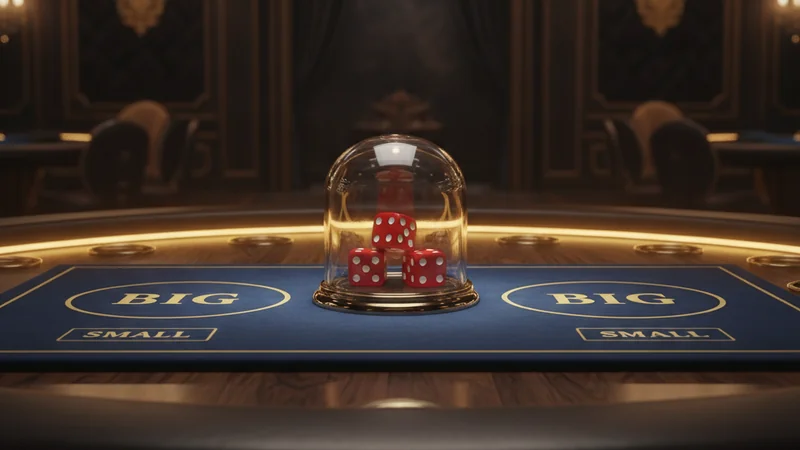
What is Big Small (Tai-Sai)?
Big Small is the simplified core of Sic Bo, two betting options that cover nearly the entire outcome range. Three dice are rolled and the total determines the result. Triple outcomes (111, 222, 333, 444, 555, 666) are exceptions that cause both Big and Small bets to lose, giving the house its edge.
How to Play Big Small
- Place Big or Small bet. Bet on the three-dice total being 11-17 (Big) or 4-10 (Small).
- Optional additional bets. Some Big Small tables offer specific total bets and triple bets from the Sic Bo bet menu.
- Dice are rolled. Three dice are shaken and revealed.
- Result. Big or Small pays 1:1. Triples cause both sides to lose.
- New round begins. Place your next bet immediately.
Strategy Tips
Tip 1: Big Small Has Near-Equal Probability
Big and Small each have a probability of approximately 48.6%, with the remaining 2.8% reserved for triples (house wins both). This makes Big Small one of the most balanced casino games available, similar to Baccarat in its simplicity.
Tip 2: No Trend Betting Required
Each roll is independent, past Big or Small results have no influence on the next roll. Avoid "trend chasing" and make each bet based on a consistent strategy rather than perceived patterns.
Tip 3: Skip the Specific-Triple Bets
Some Big Small tables tempt you with high-paying single-triple wagers (for example, all three dice showing 5s), but the chance of any one named triple landing is just 1 in 216. Those long-shot payouts look glamorous yet carry a far heavier house edge than the flat Big or Small calls. To preserve your bankroll, keep your stakes on the near-even main bets and treat triple wagers as occasional fun at most.
Which Providers Offer Big Small
Big Small is an Asian speciality, so it sits with the regional studios rather than the big European suppliers. These are the providers carried in Malaysian lobbies whose dice catalogues include it:
- SA Gaming. Runs Big Small and Tai-Sai as part of a broad Asian dice collection, usually at the lowest minimums of the three.
- Allbet. Carries the classic Asian dice formats with a plain, uncluttered betting mat that suits the single-decision game well.
- WM Casino. Presents several dice variants in a more elaborate studio setting, with Big Small among them.
Table availability is set by the operator rather than the studio and it moves, so filter the lobby by provider and check the table list before you deposit. Our live casino providers page covers who supplies what.
Why the Triple Rule Is the Whole House Edge
The elegance of Big Small is that its entire economics fit in one sentence. Three dice produce 216 equally likely combinations, the Big and Small ranges each cover 105 of them, and the six triples, all identical faces, cover the remaining 6 and defeat both sides. Those six combinations are the house's entire share, working out to the familiar 2.78% edge, and everything else about the game is a genuine coin flip dressed in dice. Knowing the mechanism matters because it inoculates you against the format's one temptation, the feeling after a run of Bigs that Small is somehow owed. The dice hold no ledger, every shake is a fresh 216, and the triples arrive on their own schedule regardless of what anyone at the table is due.
An Evening at the Table, Priced in Ringgit
Because Big Small has exactly one bet worth making, its cost is unusually easy to forecast, which is part of the appeal. A live dice round runs roughly 30 to 45 seconds once betting, shaking and settlement are counted, so 80 to 120 rounds an hour is realistic depending on the studio.
Take a MYR 20 flat stake at 100 rounds an hour. That is MYR 2,000 of turnover, and at the 2.78% edge the expected cost of the hour is about MYR 56. Halve the stake to MYR 10 and the hour costs about MYR 28. There is no clever variation on that number available to you, because there is no decision in the game to make well or badly. Stake size and round count are the only two dials, which is precisely why this table is easier to budget than any other in the lobby.
Now price the temptation. A named triple, say three fives, lands once in 216 rolls on average. Tables commonly pay these at long odds, and the arithmetic behind them is far less friendly than the main bet, which is why they sit next to it in the first place. Adding a MYR 2 named-triple bet to every round means most hours pass with nothing to show for the extra MYR 200 you staked, and the occasional hour where it lands feels like a windfall rather than the refund it partly is.
The useful comparison is the round count, not the stake. A hundred rounds an hour is roughly double a live baccarat table and more than double a dealt roulette wheel, so an identical stake costs you materially more here per hour than at the slower games, even though the edge is comparable. If you move across from baccarat, halve the stake and you will have kept your hourly exposure roughly where it was.
Decide the stake, the number of rounds and the walking-away point before the first shake, because a single-decision game gives you no natural pauses to reconsider in. Deposit limits, session reminders and Malaysian support services are set out on our responsible gambling page.
Tai-Sai's Long Road to the Live Studio
The game travelled to Malaysia the way most of the region's gambling culture did, along Chinese trade routes over centuries, under names that survive side by side today, Tai-Sai, Dai Siu, the Cantonese big-small call that gives the format its English name. It was the approachable end of the dice table long before casinos existed in their modern form, the bet a newcomer could join without learning a layout. The live studio version completes a neat historical circle, the same single decision now streamed in HD with a presenter working the shaker, and the game's survival across that distance says something real about the durability of a well-designed simple bet.
Graduating to the Full Table, or Not
Big Small is openly the gateway product, and the honest question is what comes after fluency. Sic Bo is the natural next room, the same dice with a full grid of totals, combinations and singles at a wide spread of prices, where the Big and Small bets you already know remain the value anchors. Super Sic Bo adds random multipliers for players who want the modern spike. But graduation is optional, and plenty of experienced players never leave this table, having noticed that the wider menus mostly sell worse prices with better theatre. A near coin flip at 2.78% is a genuinely defensible place to simply stay.
The Near Coin Flip as a Deliberate Choice
There is a respectable school of thought among experienced players that the simple near-even bet, taken at the best available price and left alone, is the most honest product the casino sells, and Big Small is that product in dice form. Everything else on a gaming floor adds layers, features, side bets, decision trees, each one a place for value to leak. The single-decision table has no leaks to manage because it has no decisions to botch, and its results across a year track its published mathematics with a purity the complicated games never achieve. Choosing it is not unsophistication. It is often what sophistication settles into.
The practical expression of that philosophy is a session so simple it fits on one line, a fixed stake, a fixed number of rounds, one side chosen by pure preference and held all evening. Players who run Big Small that way for a month usually report the oddest of outcomes for a casino game, sessions that behaved almost exactly as the arithmetic said they would, which is the entire promise of the format kept.
Related Reading
- SA Gaming for the studio profile behind many of the Asian dice tables in Malaysian lobbies.
- Sic Bo is the full grid this game is carved out of, with the same Big and Small bets at the same price.
- Super Sic Bo adds random multipliers to the classic layout, at a cost worth understanding before you play it.
- Fish Prawn Crab is the other three-dice regional table, scored on symbols rather than totals.
- Sic Bo strategy for Malaysian players ranks the wider bet menu by price, which is the natural next step from this table.
Common Questions
Is there any strategy at all?
Stake discipline and stopping rules, nothing else. Side preference between Big and Small is pure taste, since the ranges are mathematically identical mirrors of each other.
What happens exactly when a triple lands?
Both Big and Small bets lose, the house collects, and the round is otherwise ordinary. Some tables offer separate triple bets at long odds, priced as the lottery tickets they are.
Big Small or roulette's red and black, which is the better even-money home?
European roulette's even-money bets run 2.70% against this table's 2.78%, close enough that atmosphere should decide it. French roulette with La Partage beats both, for players choosing purely on price.
Why do some tables show streak boards for a coin-flip game?
Because players enjoy them, honestly. The boards record genuine history and predict nothing, the same as every roads display in the building, and the game's near-even structure makes that easier to verify here than anywhere, if you feel like counting.