Red Blue Duel Malaysia – Two-Dice Head-to-Head Battle Guide
A game with two mirror-image sides has to make its money somewhere, and finding out where is the only piece of homework this table asks of you. That is what this page is for. It shows you which line in the rules panel sets the price, how to turn a published return figure into a ringgit cost per hour, how the table compares with the other near-even bets in a Malaysian lobby, and why every switching system players invent here comes out the same as simply picking a colour and leaving it alone.
Red Blue Duel is a fast head-to-head dice game found in the Asian section of some Malaysian live casino lobbies. A red die and a blue die are thrown together and you back the one you think will land higher. The main bets sit close to even money and rounds resolve in seconds, which makes it one of the easiest tables in the lobby to sit down at.
What is Red Blue Duel?
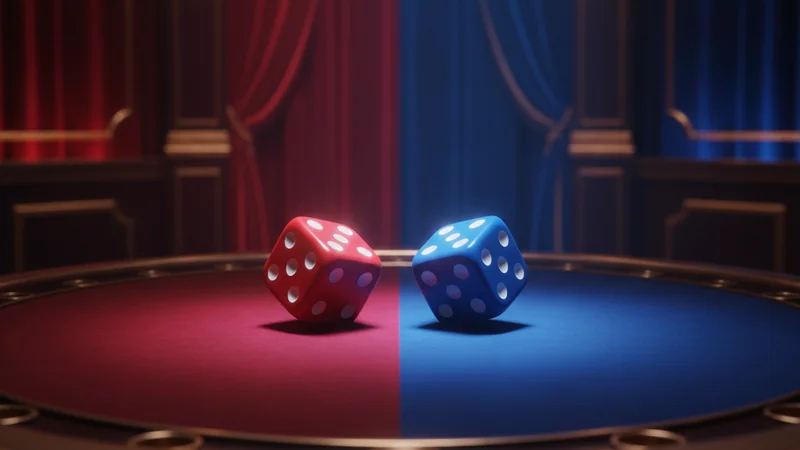
Red Blue Duel strips dice gaming down to its simplest, most exciting form: a red die and a blue die go head-to-head, both thrown at the same moment, and whichever lands on the higher number takes the round. Your only real decision is which colour you back to come out on top. Should both dice show an identical value, the round is settled as a tie, tie bets cash in at enhanced odds, while the main Red and Blue wagers either push or lose according to the specific table rules in play. It is this clean, binary contest that makes the game so quick to grasp and so popular with players who want action without a steep learning curve.
How to Play
- Choose Red or Blue. Bet on which die will roll the higher number.
- Optional Tie bet. Bet on both dice rolling the same value for a higher payout (typically 8:1 to 11:1).
- Both dice rolled. Red and Blue dice are thrown simultaneously.
- Higher number wins. The die with the higher value wins the round.
- Tie outcome. If both dice are equal, tie bets win; main bets lose or push depending on rules.
Strategy Tips
Tip 1: Red/Blue Main Bet Has Near 50/50 Odds
Each die has an equal chance of rolling higher than the other when ties are excluded. Focus on Red/Blue main bets as your core strategy and treat the Tie bet as an occasional speculative wager.
Tip 2: Apply Flat Betting
With near 50/50 main bets, flat betting (same amount each round) is the most sustainable approach. Avoid progressive betting systems that require large stakes after losing streaks.
Tip 3: Resist the Pull of the Tie Bet
Tempting as the 8:1 to 11:1 tie payout looks, both dice landing on the exact same face is a genuinely rare event, and that long-odds bet carries a far steeper house edge than the near-even Red or Blue main wager. Treat the Tie as the occasional flutter it is meant to be and keep the bulk of your bankroll on the colour duel where the maths is friendliest.
Which Providers Offer It
- Big Gaming, Technology-forward provider with Asian-themed dice games including dueling formats.
- Game Play, Offers a variety of Asian dice games including head-to-head formats.
Where the House Edge Hides in a Fifty-Fifty Game
Two dice, higher number wins, and the sides are perfect mirrors, so the margin has to live somewhere less visible. It lives in the tie. When both dice land the same face, the main bets settle by the table's tie rule, and that rule is the entire price of the game. Implementations vary between studios, some taking the full stake on a tie, some returning half, and the difference between those two treatments moves the effective edge a very long way. The rules panel states which version your table runs, and on this game that single line of fine print is the only due diligence that exists. Everything else on screen is theatre.
Read the tie rule and the tie payout together, because they have to reconcile with each other. A tie priced at long odds has to be an uncommon result, and a tie that lands often would be priced far shorter. If the two numbers on your table do not obviously fit, that is the table to walk away from rather than the one to learn the game on. We take game figures from the provider's published rules and each table's own panel rather than from memory, an approach set out in our live casino review methodology, and on a game this lightly documented we would rather send you to the panel than quote you a number.
Turning a Return Figure Into Ringgit
Once the panel gives you a return to player, the rest is one subtraction. A 97% return is a 3% house edge, so MYR 20 a round across 60 rounds in an hour is MYR 1,200 staked and roughly MYR 36 of expected cost. At a 96% return the same hour costs about MYR 48, and at 98% about MYR 24. That spread, twice the cost from one end of a plausible range to the other, is why the panel is worth ten seconds before you sit rather than a shrug afterwards.
Two practical notes follow from it. The first is that fast even-money games reach their limits sooner than they feel, so decide your round count as well as your stake before the first throw, and our responsible gambling page covers the deposit caps and session reminders worth setting up first. The second is that the same calculation lets you compare this table with anything else in the lobby, which is exactly what the next section does.
The Duel Format as Entertainment Design
The battle framing does real work. A red die and a blue die thrown together resolve identically to one die thrown twice, but the staging, opposing colours, a shared launch, a winner declared, converts a statistical event into a contest the eye can root for. It is the same trick Dragon Tiger performs with cards and Football Studio performs with commentary, and it works because humans watch duels differently from draws. The format suits the spectator mood, sessions where you want a rooting interest with minimal cognitive load, and it pairs naturally with an evening's second screen.
Playing the Near Coin Flip Well
The discipline for near-even games is settled and short. Flat stakes, a side chosen by preference and held without system, and a round count decided before the first throw.
The comparison shopping matters more than the discipline, though, because the near-even bets in a Malaysian lobby are not priced alike. Big Small offers the same coin-flip proposition at a published 2.78%, funded by an equally transparent triple rule. Dragon Tiger, which is the same two-sides-one-winner idea dealt with cards, prices its main bet at about 3.73% because ties there take half your stake. A single-zero roulette even-money bet is the cheapest of the lot at 2.70%. Set your table's published figure against those three and you will know immediately whether the duel is competitive or whether the lighting is doing all the work. Between two coin flips, the cheaper coin is the whole decision.
A Note on Streak Psychology at Mirror-Odds Tables
Perfectly mirrored games produce the purest streak illusions in the casino, and Red Blue Duel is a textbook case. Six reds in a row will happen regularly at any near-even game dealing this fast, the sequence means precisely nothing, and yet mirror-odds streaks feel more meaningful than streaks anywhere else, because the symmetry suggests a balance the universe never promised to keep. The switching systems players build here, riding streaks or fading them, all resolve to the same expected result as flat play on one colour, minus the extra mistakes that active switching invites at speed. The colour that wins next is unknowable, the price of guessing is fixed, and the calmest way to play a duel is to pick a side the way you pick a football team, once, for reasons that have nothing to do with mathematics.
That framing is also the game's best defence against its own pace, since a settled side removes the per-round decision entirely and leaves only the stake and the stopping point, the two choices that were ever real.
Common Questions
Are there side bets beyond Red and Blue?
Most tables carry a tie bet at long odds and some add exact-total wagers. All follow the universal side-bet rule, priced for entertainment rather than value, and the tie bet in particular pays spectacularly for an event whose frequency the main game's edge already depends on.
Is one colour statistically better?
No. The dice are identical and the sides are mathematical mirrors. Colour loyalty is free, so enjoy it.
What makes this different from flipping a coin?
Production, pace and the tie rule. The honest answer is that it is a coin flip with better lighting, which is exactly what its audience wants it to be.
Is this game related to any traditional format?
The head-to-head dice duel echoes street and festival dice contests found across Asia, though the studio version is a modern production rather than a preserved tradition. Its real lineage is design, borrowing Dragon Tiger's two-sides-one-winner clarity and dressing it in dice, and the borrowed clarity is exactly why it works for newcomers.
Take it for what it is, the casino's cleanest rivalry, priced by one line of tie fine print, and it makes an honest, undemanding companion for an evening.
Related Reading
- Big Gaming, one of the Asian studios carrying head-to-head dice formats for this market.
- Game Play, the other supplier most likely to have a duel table in a Malaysian lobby.
- Big Small, the near-even bet with a published 2.78% price to compare against.
- Dragon Tiger, the card version of exactly the same contest.
- Lightning Dice, if you want dice with a paytable rather than a duel.
- Live casino RTP explained, for turning a panel figure into a cost per hour.